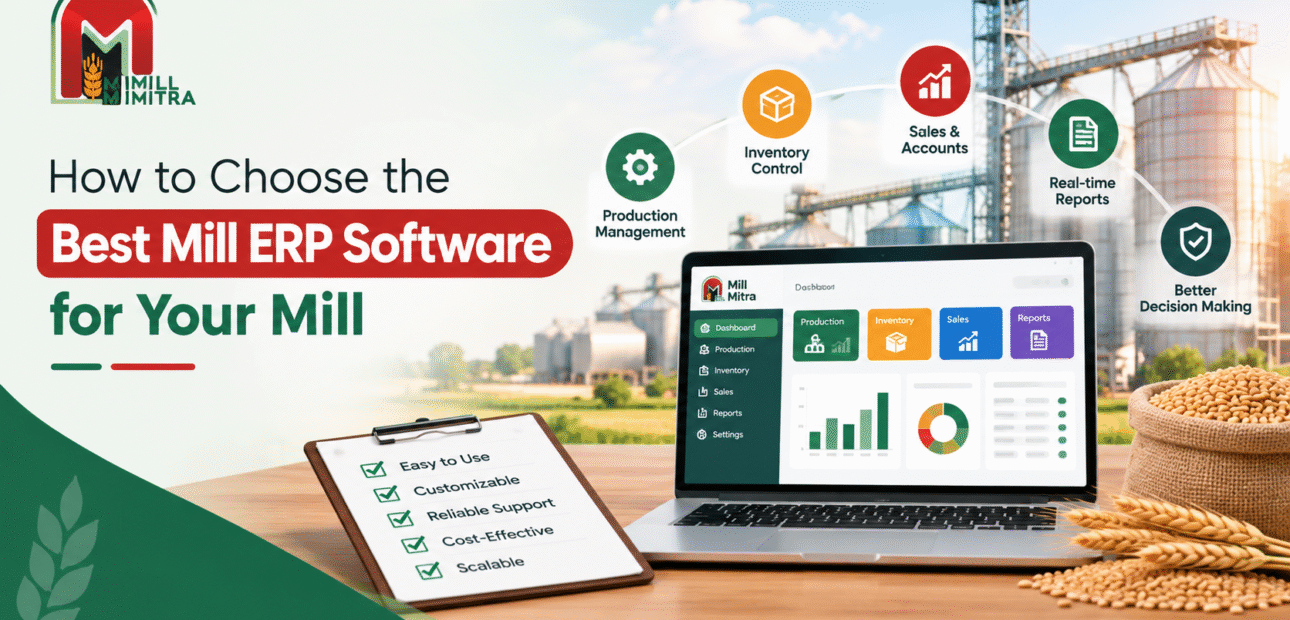
Mill ERP is the integrated software for managing a mill’s procurement, production, inventory, sales, and dispatch from one platform. With the right solution, mill owners can say goodbye to chasing registers, spreadsheets, and phone calls – and instead rely on live numbers from a centralized place. The wrong Mill ERP software, on the other hand, gets shelved after a few months. Here is how to choose the best Mill ERP software for your mill.
What should a good Mill ERP solution cover?
An effective Mill ERP solution should offer modules for end-to-end management of a mill’s operations, including:
- Procurement: purchase orders, suppliers’ details and weighbridge notes
- Production: wheat in, flour, bran and by-products out
- Inventory: raw material, finished goods and packing material
- Sales: orders, invoices and ageing reports
- Transport and dispatch: vehicle allocation and tracking
7 criteria for choosing Mill ERP software
1. Is it milling-specific?
A generic ERP system is designed around the processes of a generic factory. Milling has its peculiarities, including recovery rates and by-products, and sales in both bags and loose. Ask for a demo that is tailored around your own milling processes rather than a generic demo.
2. Can it help track yields and wastage?
Recovery rates determine profit margins, and a good Mill ERP software should be able to capture inputs and outputs for every production line and highlight any abnormal recovery or wastage rates.
Abnormal recovery rates can impact profits greatly, especially when considering continuous production over days and weeks.
3. Is it user-friendly?
Your weighbridge staff, operators, and accountants need to embrace the new technology. Most Mill ERP software has intuitive interfaces and mobile access.
4. Does it offer end-to-end visibility?
If sales and dispatch are unaware of stock availability, or if accounts and sales have no visibility into production, then it’s a Mill ERP software that is fit for a factory floor and not for a modern mill.
5. Does it offer insightful reports?
Look out for reports on daily stock position, production, party-wise ageing reports, and profitability.
6. What kind of support does it offer?
Ask about migration support, training, hours of tech support, and response time for queries, and ensure that they offer what you need in writing.
7. Can it scale with your mill?
Consider whether the software can scale as your business grows – more users, products, godowns, and even more mills without additional costs.
How to compare Mill Management Software options
Shortlist 2-3 Mill ERP software options and ask them to demonstrate how their solution would handle similar processes in your mill. For example, you could request a demo that covers a day’s procurement, production, and dispatch, followed by a comparison of fit-for-purpose, ease of use, reporting flexibility, and support. You can also ask to talk to other mill owners before making your decision.
Is there a difference between Mill ERP and Mill Management Software?
There is often little difference, and it mainly comes down to which vendor you speak to. Mill management software typically refers to systems that focus on day-to-day mill operations, and Mill ERP could offer additional features around accounting, human resources, or factory management. It boils down to the processes you need to manage on a daily basis.
What are the common mistakes when selecting Mill ERP software?
- Looking at price points while neglecting support
- Not testing the software with your data
- Buying modules you will not use for years
- Failing to train staff before implementation
Where does Mill Mitra fit in?
Mill Mitra is a mill management software and mobile app that helps you digitize procurement, production, inventory, sales, transport, and dispatch. Mills that want to operate on a fully integrated, end-to-end software platform can use Mill Mitra as a benchmark while considering other Mill ERP software options.
Conclusion
The best Mill ERP software is one that is compatible with your mill’s daily operations, adopted by your staff, and offers trusted insights. By prioritizing your requirements and testing them with a free demo, you can make a more informed decision when comparing Mill ERP software options.
Consider what keeps you up at night and start your shortlist from there.
FAQs
It is software that integrates a mill's procurement, production, inventory, sales, dispatch, and often accounting into one system, replacing manual records and disconnected tools.
At minimum: purchase and stock tracking, production and recovery records, sales and invoicing, dispatch management, and owner-level reports.
Accounting software records financial transactions. A Mill ERP solution also tracks physical operations such as grain intake, yield, stock, and vehicle dispatch.
Yes, if the system is simple, priced sensibly, and covers your core workflows. Start with essential modules and expand later.
It varies by vendor, data volume, and number of users. Ask for a written timeline covering data migration and training.
It can make losses visible by comparing input and output for each run and highlighting variance, so you can investigate causes. It does not remove losses by itself.
Cloud or app-based systems offer remote access and easier updates. On-premise suits mills needing local control. Weigh internet reliability, data policies, and IT capacity.
If stock mismatches, delayed reports, manual entries, or poor dispatch visibility are regular problems, you are likely ready.
A WordPress Commenter July 7, 2025
Hi, this is a comment.
To get started with moderating, editing, and deleting comments, please visit the Comments screen in the dashboard.
Commenter avatars come from Gravatar.