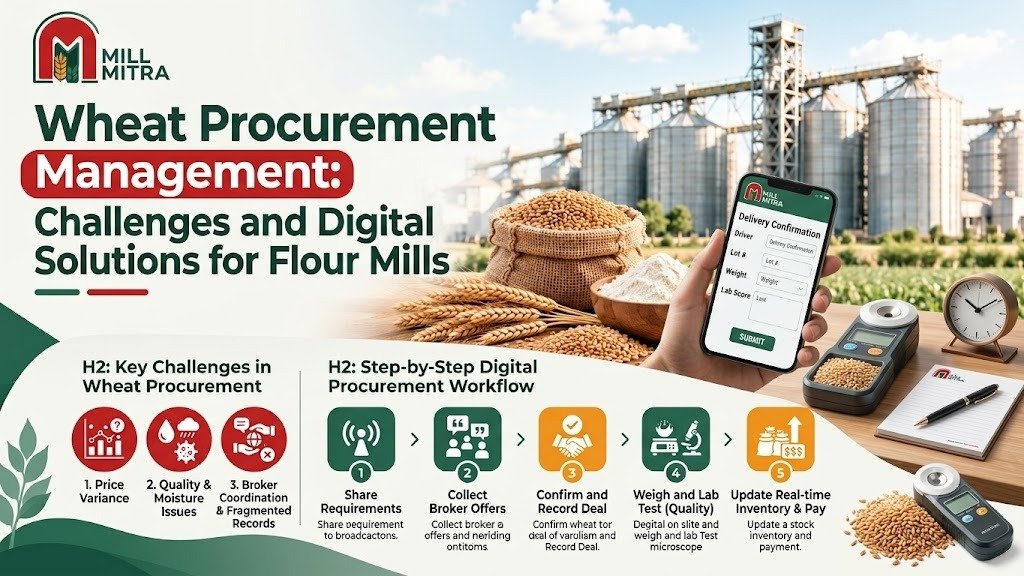
What the flour mill procures next after its wheat purchase will determine everything else after that – from its recovery rate to its margins. However, in many mills, procurement happens through phone calls, handwritten notes, WhatsApp messages, and various spreadsheets.
It is okay for procurement to happen this way if you are purchasing small amounts. However, once you start procuring wheat from different states, working with several agents, and receiving truckloads daily, this method becomes inadequate.
This article will tell you about wheat procurement management, problems associated with this procedure, and how digital means of procurement can help in organizing the process.
What Is Wheat Procurement Management?
Procurement Management of Wheat refers to planning, purchasing, sourcing, testing, and payment of wheat for a flour mill such that it gets the right quality of wheat in the correct quantity at the correct price and time.
It does not only involve buying but entails:
- Raw material requirement estimation
- Monitoring prices and offers from suppliers
- Deal negotiation and confirmation
- Transportation arrangement
- Truck weighing and off-loading
- Grain quality testing
- Inventory recording and payment processing
Without a proper system, and with these processes scattered across different books, phones, and folders, even minor mistakes can lead to losses.
Why Procurement Matters So Much for Flour Mills
Grain is by far the most significant source of expense in a flour mill. Even the smallest change in buying price, moisture content, or quality of grain is going to be reflected in every tonne that you grind.
- Effective procurement management enables a flour mill to:
- Procure at advantageous prices through swift comparison of bids
- Avoid any fluctuations in grinding through avoidance of stock shortages
- Ensure uniform quality of flour
- Minimize conflicts with brokers/transporters
- Control working capital
Simply put, procurement is not an administrative function. It is a business activity.
How Wheat Procurement Typically Works in a Mill
All these milling units go through a process flow of the following nature, irrespective of whether the planning is done through a manual process or a software-based one:
- Requirement Planning – The procurement department plans the requirement of wheat in terms of quantity and region.
- Sourcing – Brokers/suppliers give quotes.
- Quotation acceptance – The mills accept the quantity/rate/period of supply.
- Transportation – Truck booking is done by the mill or broker.
- Entry through the gate and weighing – The truck enters and gets weighed.
- Quality check – Laboratory/Quality manager checks the moisture level and foreign content in the wheat.
- Loading/unloading and entry into stocks – The wheat is loaded/unloaded, and entry is made in stocks.
- Reconciliation and Payment – Invoice reconciliations and payments are done
Key Challenges in Wheat Procurement Management
1. Price Variance and Ineffective Time Management for Purchasing
Prices for wheat are influenced by harvest conditions, government regulations, local demand, and availability of stock. When pricing information is communicated via phone calls and SMSes, buyers are usually unable to compare and make the proper decision regarding timing.
Purchase Executive may be unaware of whether the price he/she received yesterday from a particular broker is lower than a new quote received from another broker today. The lack of a database makes price comparison entirely dependent on memory.
2. Inconsistency in Quality and Problems with Moisture
The quality of wheat is not consistent. It differs by location, variety, harvesting season, and storage.
Weather increases this problem. In the harvesting season of 2026, there have been media reports from areas in North India that describe the rejection of rain-affected batches due to moisture, discoloration, and shriveled grain. The government agencies purchasing at minimum support prices normally have a moisture tolerance of about 12 percent, and this is often under discussion during the monsoon season. Similarly, the private mills will have this problem because poor-quality grain affects the milling process.
Lab analysis results recorded on paper or not associated with your purchase make it difficult for you to hold suppliers accountable or identify the source of high-quality wheat.
3. Brokers and Suppliers Coordination
Most mills have a chain of brokers in various states. It takes a lot of time to coordinate the requirements, collect offers, and confirm the deals through this chain.
The common issues are:
- The requirement is posted several times in different communication channels
- Offers are lost in the chat discussions
- There is no unified list of what offers were made and at what price
- Misunderstandings about the terms agreed on
4. Delay at the Truck, Gate and Weigh Bridge
A truck that does not have a purchase reference delays everything. The gate department has to know what deal it relates to. The weighbridge department has to make the correct entry. The lab department has to connect the sample with the corresponding lot.
If this information exchange is made via phone calls, there are delays for trucks.
5. Fragmentation of Records and Payment Dispute
Buy rates, weights, deductions on quality, and payments are kept separately. By the end of the month, the accounts department has to put all that together.
Here come the disputes: an error in weights, a quality deduction that was not recorded, or a payment that does not tally with the initial agreement.
6. Poor Inventory Visibility and Traceability
When inventory is maintained manually and late, the purchasing department does not have the actual inventory level at the time of making a purchasing decision. The mill will either overpurchase and tie up money or underpurchase and be in shortage.
Traceability becomes difficult too. In case a quality issue comes out in flour, tracing this back to the actual lot of wheat, supplier, and truck becomes impossible.
What Are the Digital Solutions for Wheat Procurement?
Digital wheat procurement applications are a kind of software that keeps track of the entire procurement process, including purchasing, receipt, quality checking, and payment of wheat, all through one software application.
Two such types are:
A grain procurement application is concerned only with the purchase process of wheat, including needs, offers from brokers, purchase confirmation, truck dispatching, weighing, quality testing, and vendor details.
The flour mill enterprise resource planning application is a more comprehensive software. This involves not only procurement but also manufacturing, inventory, sales, dispatching, and accounting processes.
This is normally implemented in business environments where there is a need to minimize manual errors and hasten decision-making processes while maintaining an audit trail of the entire transaction process.
How Digital Tools Improve Each Stage of Procurement
| Stage | Common manual problem | What digital software changes |
|---|---|---|
| Requirement and sourcing | Offers scattered across calls and chats | Requirements are shared once, and offers are collected in one place |
| Deal confirmation | Verbal agreements, later disputes | Rate, quantity, and terms are recorded against the deal |
| Truck and gate entry | Trucks arrive without clear references | Each truck is linked to a confirmed purchase |
| Quality check | Paper lab reports, no supplier history | Test results are stored against the lot and the supplier |
| Stock update | Delayed, manual entries | Inventory updates as wheat is unloaded |
| Payment | Mismatched weights and deductions | Payments follow recorded weights and quality results |
Features to Look for in Grain Procurement Software
Not all tools suit all mills. When choosing among the possible solutions, consider the following features:
- Brokerage and offer management: A methodical process of exchanging requirements and offers.
- Businesses and orders management: Status of each order from agreement to delivery.
- Vehicle and weighbridge logs: Entries linking each vehicle to its order.
- Lab and quality module: Storage of moisture and other testing results per lot.
- Real-time inventory: Inventory reflecting incoming and outgoing wheat.
- Role-based security: People will have access to the pieces they need.
- Linked modules: Procurement module linked to the production, sales, dispatch, and accounting modules.
- User-friendly on mobile: People in charge of the floor, brokers, and supervisors should be able to work with it easily.
Over-complicated tools tend to remain unutilized. Ease of everyday work is equally important as the feature set.
How to Move From Manual to Digital Without Disruption
You do not need to change systems immediately. The following method is often more effective:
- Describe your existing process. Record how a sale is handled from a requirement to paying for the product.
- List the pain areas. Is it the brokers, trucks, or the inventory?
- Begin with procurement. Automate procurement and receiving.
- Train users by job. Provide the right screens for each role.
- Extend to other modules. Introduce production, sales, and dispatch when the team is ready.
- If necessary, use both processes together temporarily until the numbers add up.
Common Mistakes to Avoid
- Purchasing software prior to designing the process. The software can’t solve the problem with an undefined process.
- Failing to consult the floor staff. If supervisors and laboratory teams have difficulty using it, data will not be entered in a timely manner
- Maintaining double entries for too long. Double entry is one thing that stops adoption.
- Not taking quality data seriously. Without supplier-wise quality history, your sourcing won’t improve.
Conclusion
Effective wheat procurement management involves three factors: timing of purchase, right quality of wheat, and maintaining good records of the transaction and the payment for it. The manual processes fail to achieve all of these aspects together once the mill becomes larger in size.
Using grain procurement software along with flour mill ERP software provides one common view of the procurement process for the millers. For the millers who want to avoid disputes and make quick decisions regarding their largest cost aspect, improvement in wheat procurement management can be a logical first step. Strategic Management Consulting can further help mills identify process gaps and prioritize improvements.
FAQs
It is the process of planning, buying, receiving, testing, and paying for wheat so the mill has the right quality and quantity of grain on time and at a manageable cost.
The most common challenges are price movement, quality and moisture variation, broker coordination, truck and gate delays, scattered records, and poor stock visibility.
Grain procurement software is a digital tool that records requirements, supplier offers, deals, truck arrivals, weighment, quality results, and payments in one system, replacing paper and chat-based tracking.
Grain procurement software covers the buying side. Flour mill ERP software connects procurement with production, inventory, sales, dispatch, and accounts on a single platform.
It stores lab results against each lot and supplier, so mills can compare sources over time, document deductions, and reduce quality disputes.
Yes. Many mills start with procurement and receiving, then add other modules as their team becomes comfortable. Choosing a tool that is simple to use is more important than choosing the longest feature list.
Check how well it handles broker offers, truck and weighbridge entries, quality records, real-time inventory, role-based access, and whether it connects to production, sales, and accounts.
Record every deal's rate, quantity, and terms in a shared system, link each truck to a confirmed deal, and base payments on recorded weights and quality results.