The stock in a flour mill does not go down through any single incident. It is lost slowly through various means. A small amount of flour may be lost between the weighbridge and the godown. A bin is topped up even when not fully emptied. The amount of bran used is estimated rather than weighed. An order goes out of the gates without any corresponding entry.
When these small losses accumulate, they can result in significant stock shortages.
Flour mill inventory management helps mills identify and control these losses. This manual will show you where stock loss takes place and how you can practically reduce it, from wheat receiving to final dispatch.
What Is Flour Mill Inventory Management?
Inventory management for flour mills is the system that ensures control of all materials used in the flour mills, including wheat, finished goods like atta, maida, and suji, by-products such as bran, packing materials, and consumable items. This starts from the time the load comes to the mill until it exits the gate.
If there is an effective system in place, then you will be able to answer the following questions at all times:
- What stock do we have?
- Where is it located?
- What is the status of the stock?
- Is the book stock tallying with the actual stock?
If you fail to answer all the above questions, then stock loss is definitely going undetected.
Where Do Flour Mills Lose Stock?
There are two forms of stock loss at a flour mill: physical stock loss and record stock loss. Physical stock loss includes spoilage, pest infestation, spillage, and moisture fluctuation. While the record stock loss entails errors in record entry, non-availability of weights, and mismatched dispatches. Most mills have both of these categories.
Physical Loss
Studies conducted on wheat storage in warehouses indicate that environmental factors, storage structure, duration for which the grain is stored, and handling are some of the factors that result in losses during storage. Moisture, insects, microorganisms, and rodents are the biological causes of these losses. But the studies also suggest that proper storage management leads to minimal losses. As per Food Corporation of India records, in the last three years of wheat storage, only 0.3% was lost through storage.
As per the audit report, the wheat damage is because of improper storage practices, inadequate preservation techniques, and the storage of fresh wheat along with infested wheat in Punjab. Similarly, the wheat damage in Haryana was because of internal control and monitoring weaknesses. This includes public procurement agencies and not private mills.
Record loss
Poor records mean losses even if the quality of grain is good. An investigation into flour mills in Nigeria established that shrinkage of inventory led to low customer satisfaction and inventory control was associated with cost effectiveness. Additionally, it established that many middle-sized milling firms base their inventory decisions on fluctuations in demand, tradition, estimates, and forecasts, and not on models.
The common sources of loss:
- Receiving: Trucks not weighed or graded, lack of moisture checks, acceptance of short supplies.
- Storage: Mixing of supplies, old supplies covered up by new ones, damp or infected areas.
- Milling: Discrepancies between the amount of wheat issued and the output of flour and by-products.
- Dispatch: Loads whose weights do not match those on invoices, informal sales.
- Paperwork: entries made late, from memory, or by people who should not have access.
Best Practices to Reduce Stock Loss in a Flour Mill
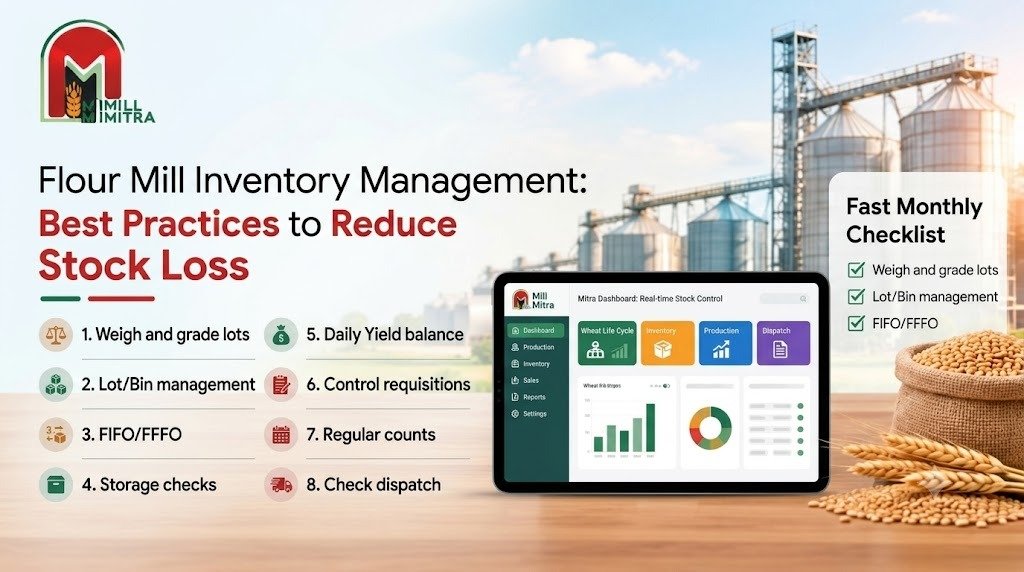
1. Weigh and grade all lots on entry to the site
Make the entry to the weighbridge the start point for recording. Gross weight, tare, net weight, supplier, truck number, and time should all be recorded, along with having your lab or quality person assess moisture content and basic quality prior to offloading. Non-conforming lots should be flagged and recorded, rather than quietly accepting them.
2. Manage wheat stocks by lot, bin and quality
Proper wheat stock management requires more than knowing quantities. All lots should be tracked individually by origin, date received, quality results, and place of storage. In cases where there is a quality issue in the flour, lot-by-lot tracking will enable you to determine which lot of wheat caused the problem.
3. Adhere to FIFO and segregate non-conforming lots
Adherence to FIFO ensures that the older lots of wheat are used first. For packaged flour, FFFO should be applied. Segregate infested, wet, or suspicious lots from good lots. Combining fresh wheat with a problematic lot is among the easiest ways of causing damage to your stock.
4. Manage storage facilities
Inspect godowns and silos at predetermined intervals. Observe moisture content, leakage, temperature, pest and rodent presence, and document what you observe. Ensure that stacks do not touch the ground, create inspection paths, and completely clean empty bins prior to reloading. It would be prudent to maintain an inspection log as well.
5. Balance the milling yield every day
The practice which tends to be neglected the most. Every day, compare the quantity of wheat issued for processing versus what you produced: flour products, bran, and other by-products, taking into account allowable wastage. The yield going in the wrong direction may indicate inaccurate weighing, milling equipment settings, changes in wheat quality, or stealing.
Determine your own benchmarks based on your previous experience. There is no need to use a figure from another company’s operations, since wheat type, moisture, and machines are different there.
6. Controlling requisitions and usage
There shouldn’t be any departure from the warehouse without a proper requisition and entry. It applies to wheat requisitioned for production and also packing materials, threads, spare parts, and other consumables. The policy that has always proved to work is: ‘no requisition, no issue’. Appoint someone specific to authorize and someone specific to receive.
7. Regular counting, not year-end only
Yearly stocktaking is too late to identify the problem areas. You can perform cycle counting instead. Some quantities or locations should be counted each week, and high-value or fast-moving quantities more frequently. Compare actual inventory with the book one, look into every discrepancy, and document the cause.
8. Matching dispatch to weighbridge and invoice
Before loading the truck, check that the weight of the load, the dispatch document, and invoice correspond. Vehicle number, driver data, and destination should be recorded. A discrepancy at this point is costly to sort out afterwards and often leads to arguments with customers or carriers.
Do You Need Flour Mill Inventory Software?
Flour mill inventory management software allows you to record wheat, production, finished products, by-products, and despatch in one place so that the stock gets updated as the work is done. This software is generally used by firms to consolidate registers and reduce errors while providing the status of stock without waiting for month-end reports.
For small-scale chakki, it may not be necessary to use software, but it becomes useful once there are multiple people managing stocks, trucks are bringing wheat daily, or there is a multiple product line operation.
- In selecting software, it needs to be verified whether the software can:
- Capture weighbridge and unloading entries for each lot.
- Provide stock by lot, locations, and quality.
- Trace the issue of wheat to production along with the output of flour and by-products.
- Provide separate access to different roles (store, lab, production, despatch).
- Maintain an audit trail for changes made.
- Generate stock, yield, and variances reports without manual effort.
This is precisely the type of challenge for which Mill Mitra was designed. The application handles the wheat life cycle from procurement through to sales, keeps track of raw material and product inventories, tracks requisitions and consumption, and provides role-based user access, including for supervisors, lab technicians, and inventory managers. Procurement, production, inventory, sales, transportation, and dispatch are all managed on one single platform; therefore, an entry on the inventory side in one place can always be verified against the next step in the process, where errors usually occur.
No matter which tool you pick, the software cannot correct an unorganized process. Establish the rules first, and then allow the system to enforce them.
Fast Monthly Checklis
- Weighbridge records correspond with unloading and stock-in records.
- Each consignment has quality information and godown position information.
- Oldest stock is consumed before latest stock.
- Godown inspection is documented.
- Daily yield reconciliation is completed.
- Cycle counts have been completed with reasons.
- Despatch quantities correspond with invoices.
- Damages are documented with reasons.
Conclusion
Effective flour mill inventory management depends on a few good practices done consistently: weighing at the gate, counting by batch, safeguarding stock in the warehouse, reconciling yield daily, controlling issues, counting often, and verifying dispatch. Every single practice seals a particular gap. Taken together, they make flour stock loss quantifiable and hence controllable.
Begin by addressing the two or three areas where you lose the most money, such as yield variances or receiving errors. Expand on these and consider flour mill inventory software when your system gets cumbersome. A Digital Strategy Consultant can also help identify opportunities to improve inventory processes and make better use of technology as your business grows.
FAQs
It is the process of tracking and controlling wheat, flour products, by-products and packing material from receiving to dispatch. The goal is to keep book stock and physical stock aligned and reduce avoidable loss.
Weigh and grade every lot at receiving, store lots separately, use FIFO, inspect storage regularly, and reconcile milling yield daily. Separating infested or damp stock from clean stock also prevents damage from spreading.
Moisture, insects, microorganisms and rodents are the main biological causes. Storage structure, how long grain is held, and packing and handling methods also play a role.
Run cycle counts weekly or fortnightly for key items, and count high-value or fast-moving items more often. A full physical count can still be done periodically, but it should not be the only check.
Weigh by-products at the point they are produced and record them against the production batch. Then compare wheat issued with flour plus by-products plus wastage. Estimated by-product quantities hide losses.
It records receiving, storage, production, by-products, sales and dispatch in one system, updates stock as entries are made, and produces variance and yield reports. Role-based access and audit trails also reduce unauthorised changes.
Yes. The issues faced by small mills are the same as larger mills, just on a smaller scale. Choosing a simple enough system that does not require advanced training is important.